


Competitive Architecture (CA)
A methodology to elevate organizational performance in hypercompetitive environments
The Competitive Architecture (CA) methodology enables organizations to effectively face the challenges of hypercompetitive markets by both strengthening the structural foundations of performance and developing new sources of competitiveness grounded in the authentic management of emotional energy and comprehensive coherence.
Its implementation drives a corporate transformation toward a new competitiveness paradigm, reinforcing the internal coherence required to sustain superior positioning in demanding and volatile environments.

CA provides the operational pathway through which Prestige-Based Competitiveness becomes achievable.
The Structural Erosion of Competitiveness
Systemic deficiencies continuously erode organizational performance across all contexts, with amplified impact in hypercompetitive environments.
Organizations are not primarily constrained by external market conditions, but by internal structural deficiencies that operate continuously and cumulatively over time.
These deficiencies weaken the core drivers of performance across any environment, progressively degrading execution, value creation, and strategic resilience—while their impact becomes significantly more severe under hypercompetitive conditions.
| Structural Sources of Competitiveness Erosion | Component Lost | Structural Effect of Loss | Impact on Profitability* |
|---|---|---|---|
Strategic Inconsistency Driven by lack or insufficiency of: | Hexa-faceted Identity → Coherence → Strategic Vision Elevation → | weakened emotional anchoring. fragmented bonding and degraded execution reliability. degraded decision quality. | 10–15% |
Executive Fragility Driven by lack or insufficiency of: | Applied Behavioral Mastery → Role-Integrated Capability → Execution Maturity → | reactive problem handling. execution misalignment. shallow problem resolution. | 15–20% |
Operational Weakness Driven by lack or insufficiency of: | Market-Anchored Purpose → Operational Flow Efficiency → Embedded Quality Assurance → | offering–expectation misalignment. productivity erosion. defect amplification and cost leakage. | 20–25% |
Substantive Value Deficit Driven by lack or insufficiency of: | Customer-Relevant Value Fit → Value Creation Coherence → Competitive Distinctiveness → Market Prestige → | value irrelevance and demand erosion. margin instability. price-driven substitution. price sensitivity and loyalty decline. | 15–25% |
Shallow Commercial Connection Driven by lack or insufficiency of: | Deep expectation insight → Emotional resonance in interaction → Robust customer-brand bonding → | ineffective selling activity. inability to generate substantive added value. non-resilient customer-brand bonding, limiting loyalty development. | 10–20% |
Systemic Effect
When multiple deficiencies coexist, their effects compound rather than accumulate.
The simultaneous erosion of several structural domains accelerates the degradation of competitiveness, significantly limiting an organization’s capacity to sustain superior performance over time.
Beyond Fragmented Management Approaches
Traditional management models tend to address these deficiencies in isolation—through strategy, operations, or leadership interventions—without resolving the underlying structural misalignment between emotional energy, organizational architecture, and execution systems.
As a result, recovery is often partial and insufficient to restore the full spectrum of lost performance. When this occurs in hypercompetitive environments, sustained external pressure further amplifies internal weaknesses, progressively undermining the organization’s capacity to compete.
If unaddressed, this dynamic may lead to structural degradation that surpasses a critical threshold, beyond which competitiveness can no longer be fully recovered through conventional improvement approaches—compromising the organization’s long-term positioning and viability.
The CA Conceptual Framework
A systemic model to generate, structure, and sustain competitiveness through emotional energy and coherence
Emotional Energy as a Structural Driver of Competitiveness
Competitiveness is not only determined by strategy, operations, or market positioning, but by the organization’s capacity to generate, structure, and sustain emotional energy across all its domains.
Within the CA framework, emotional energy is not treated as a subjective or secondary factor, but as a structural variable that drives perception, behavior, decision-making, and relational dynamics.
When authentically managed—requiring a process of personal transformation—it becomes a generative force that enhances coherence, strengthens decision-making and execution, and enables the creation of superior and sustainable value.
The Dynamics of Emotional Energy
- Generating emotional energy
- Shaping emotional energy
- Driving emotional energy
- Channeling emotional energy
Each process fulfills a distinct function; however, the effectiveness of the system depends on the coherent interaction between all four dynamics, not on any individual element in isolation.
The following framework integrates the core dynamics, domains, and criteria through which emotional energy is structurally translated into competitiveness.
| Element Type | Core Elements | ||||
| Dynamic | Generating emotional energy | Shaping emotional energy | Driving emotional energy | Channeling emotional energy | Conceptual Driver An intangible energy construct that provides the theoretical generative principle of the model. |
| Factor | Person | Object | Structure | Connection | Structural Targets Determinant domains in which intangible energy becomes structurally embodied and translated into organizational architecture and competitive capacity. |
🠗Consistency | |||||
| Criteria | Fullness → Energetic amplitude and qualitative intensity | Substantiveness → Depth and structural meaningfulness of value | Robustness → Durability and structural stability under pressure | Rapportness → Strength of relational bonding and reciprocal affinity | Qualitative Lenses Interpretive dimensions used to assess the developmental condition of each structural domain. |
| Purpose | Expansion of problem-solving capacity and adaptive agency. | Generation of distinctive, valued, durable, and resonant contributions. | Enhancement of systemic coherence and adaptive productivity. | Consolidation of structurally reinforced trust and sustained loyalty. | Functional Roles System-level intents defining the contribution of each domain to competitiveness. |
🠗Strategic Coherence | |||||
| Component | Executiveness | Vector Program Engineering | Integrated Workflow | Perceptive Resonance | Methods & Tools Operational mechanisms through which conceptual principles are institutionalized. |
Structural Domains of Competitiveness
Emotional energy becomes competitively relevant only when it is structurally embedded across key organizational domains. These domains define how energy is translated into performance and competitiveness.
- Person — where energy is generated and activated
- Object (Value) — where value is defined and shaped
- Structure — where execution is organized and sustained
- Connection — where relationships and market interactions are established
Qualitative Criteria of Development
The development of each structural domain depends on qualitative conditions that determine its capacity to sustain competitiveness over time.
- Fullness — energetic amplitude and qualitative intensity
- Substantiveness — depth and structural meaningfulness of value
- Robustness — durability and stability under pressure
- Rapportness — strength of relational bonding and reciprocal affinity
The effectiveness of the system does not depend solely on the development of individual domains, but on the degree of coherence achieved across them.
Coherence ensures that emotional energy is consistently aligned with strategy, structure, value, and interaction—eliminating fragmentation and enabling synchronized execution.
Within the CA framework, coherence operates at two levels:
- Conceptual consistency — alignment of meaning, criteria, and direction
- Strategic coherence — systemic integration across all domains
It is this dual coherence that allows organizations to convert internal capability into sustained competitive advantage.
From Conceptual Logic to Organizational Application
The Competitive Architecture framework provides the conceptual logic required to understand how competitiveness is generated and sustained.
Its practical implementation is achieved through a set of integrated components that translate this logic into organizational systems, processes, and practices.
These components enable emotional energy to be generated, structured, aligned, and directed toward coherent execution and sustained competitive performance.
Together, the framework and its operational components constitute the Competitive Architecture methodology.
The CA Operational Structure
A structured system of components, capsules, and tools to operationalize emotional energy and coherence
From Conceptual Framework to Operational Components
The CA conceptual framework defines the structural logic through which competitiveness is generated and sustained. Its operationalization requires embedding this logic into a system of components that translate emotional energy into consistent, scalable execution.
Within CA, competitiveness is not improved through isolated initiatives, but through the coordinated deployment of integrated components, each activated through specific capsules and supported by dedicated tools.
Component-Based System of Implementation
Each component is deployed through a set of capsules and supported by specific tools, forming a scalable system that ensures consistent execution across the organization.
Strategic Coherence (Consistency)
The organization’s capacity to perceive, interpret, and position itself within the competitive environment in a coherent and prestige-driven manner.
Strategic Architecture
Executive Architecture
Decision Integrity
Executiveness (Fullness)
The capacity to generate emotional energy and convert it into focused, goal-directed action to consistently deliver results in hypercompetitive environments.
Solving Capability
Performance Suitability
Executive Development
Vector Program Engineering (Substantiveness)
A program engineering approach that translates corporate purpose and customer meta-expectations into differentiated, high-value offerings.
Corporate Identity
Outperforming Value
Positioning
Integrated Workflow (Robustness)
A structural model that harmonizes resources, processes, and control mechanisms to ensure stable, efficient, and high-performance execution.
Operational Core
Operational Development
Operational Capacity
Perceptive Resonance (Rapportness)
A strategic capability that integrates deep customer insight and emotionally driven interaction to generate meaningful connection and sustained market impact.
Customer Insight
Evoking Delight
Eventcasting
Operationalization Through Methods and Tools
Each capsule is supported by specific tools that enable both execution and measurement, ensuring that conceptual principles are consistently translated into operational practice and measurable outcomes.
These tools ensure that conceptual principles are consistently translated into operational practice and measurable outcomes.
Strategic Coherence as Systemic Integration
Strategic coherence integrates all components, capsules, and tools into a unified system, ensuring that behavior, value, execution, and interaction operate in alignment rather than isolation.
This integration enables continuous feedback, systemic stability, and sustained competitiveness under dynamic conditions.
Implementation of the CA Methodology
A structured, phase-based approach to deploying CA in real organizational contexts
A Structured Process of Systemic Transformation
The implementation of CA is a structured transformation process in which all components evolve simultaneously and coherently across progressive stages of development.
Rather than producing immediate or isolated improvements, CA drives a cumulative progression in which structural capabilities are gradually strengthened, integrated, and institutionalized across the organization.
This progression typically unfolds through successive stages—ranging from initial definition to full systemic integration—each associated with increasing levels of performance recovery and competitive capability.
Each stage reflects a higher level of structural maturity, in which capabilities evolve from definition to full institutionalization across the organization.
As the system evolves:
- Structural foundations are progressively reinforced
- New sources of competitiveness are activated
- Organizational capabilities become more robust, coherent, and resilient
This staged transformation enables organizations not only to recover lost performance, but to reach higher levels of sustainable competitiveness under increasingly demanding conditions.
The evolution across stages can be monitored through defined maturity levels and associated performance ranges, providing a structured reference for assessing progress and guiding transformation.
The following model relates structural maturity stages to progressive performance recovery across the main domains of competitiveness erosion.
Stages of Structural Maturity and Performance Recovery
| Structural Sources of Competitiveness Erosion | Component Lost | Structural Effect of Loss | Impact on Profitability | Stage 1 → Seedling 0–5% |
Stage 2 → Sapling 5–9% |
Stage 3 → Mature 9–13% |
Stage 4 → Prime 13–15% |
|---|---|---|---|---|---|---|---|
|
Strategic Inconsistency Corporate Purpose Strategic Structuring Discipline Explicit Criteria Enrichment |
Hexa-faceted Identity Coherence Strategic Vision Elevation |
Weakened emotional anchoring Fragmented bonding and degraded execution reliability Degraded decision quality |
10–15% | Defined | Integrated | Embedded | Institutionalized |
|
Executive Fragility Behavioral Capability Awareness Capability-Role Alignment Structured Executive Development |
Applied Behavioral Mastery Role-Integrated Capability Execution Maturity |
Reactive problem handling Execution misalignment Shallow problem resolution |
15–20% | Defined | Integrated | Embedded | Institutionalized |
|
Operational Weakness Systematic Capture of Customer Expectations Process Fluidity and Cross-Functional Integration Intrinsic quality control mechanisms |
Market-Anchored Purpose Operational Flow Efficiency Embedded Quality Assurance |
Offering-expectation misalignment Productivity erosion Defect amplification and cost leakage |
20–25% | Defined | Integrated | Embedded | Institutionalized |
|
Substantive Value Deficit Offer-Customer Expectation Alignment Structural Value-Creation Architecture Differentiated Positioning Perceived Superiority |
Customer-Relevant Value Fit Value Creation Coherence Competitive Distinctiveness Market Prestige |
Value irrelevance and demand erosion Margin instability Price-driven substitution Price sensitivity and loyalty decline |
15–25% | Defined | Integrated | Embedded | Institutionalized |
|
Shallow Commercial Connection Structured listening discipline in customer interaction Capability to access deeper layers of expectations Robustness of relational engagement |
Deep expectation insight Emotional resonance in interaction Robust customer-brand bonding |
Ineffective selling activity Inability to generate substantive added value Non-resilient customer-brand bonding |
10–20% | Defined | Integrated | Embedded | Institutionalized |
* Structural erosion ranges represent potential impact within each domain. When multiple domains deteriorate simultaneously, effects compound and may exceed 50% cumulative competitiveness degradation.
Together, this architecture enables organizations to manage competitiveness as a structured, measurable, and continuously evolving system.
From Architecture to Structured Deployment
The CA operational architecture defines how competitiveness is structurally built. Its implementation follows a structured process through which components, capsules, and tools are deployed in alignment with the organization’s strategic intent and structural condition.
This process is organized into sequential phases that ensure clarity, alignment, and viability before full transformation is activated.
Phase 1: Assessment and Alignment
The first implementation phase is operationalized through a structured decision-support sequence that integrates expectations, diagnostics, capability assessment, and strategic formulation.
1. Expectations — What do we want?
- Identification of top management meta-goals
- Clarification of strategic intent and ambition level
- Capture of desired positioning and performance expectations
2. Performance Diagnostics — Where are we?
- Evaluation of current performance across structural domains
- Identification of systemic deficiencies
- Assessment of competitiveness condition
3. Executiveness Assessment — What do we need?
- Evaluation of behavioral capability and role alignment
- Identification of gaps in execution capacity
- Definition of capability requirements
4. Methodology Alignment — What can we do for you?
- Intensive seminar (typically two days)
- Alignment on CA principles and structure
- Shared understanding of transformation process
5. Strategic Viability Decision
- Evaluation of feasibility and alignment
- Decision regarding continuation
If viable, a customized Enterprise Strategy is developed including Corporate Purpose, Market & Growth Model, and Competitive Strategy.
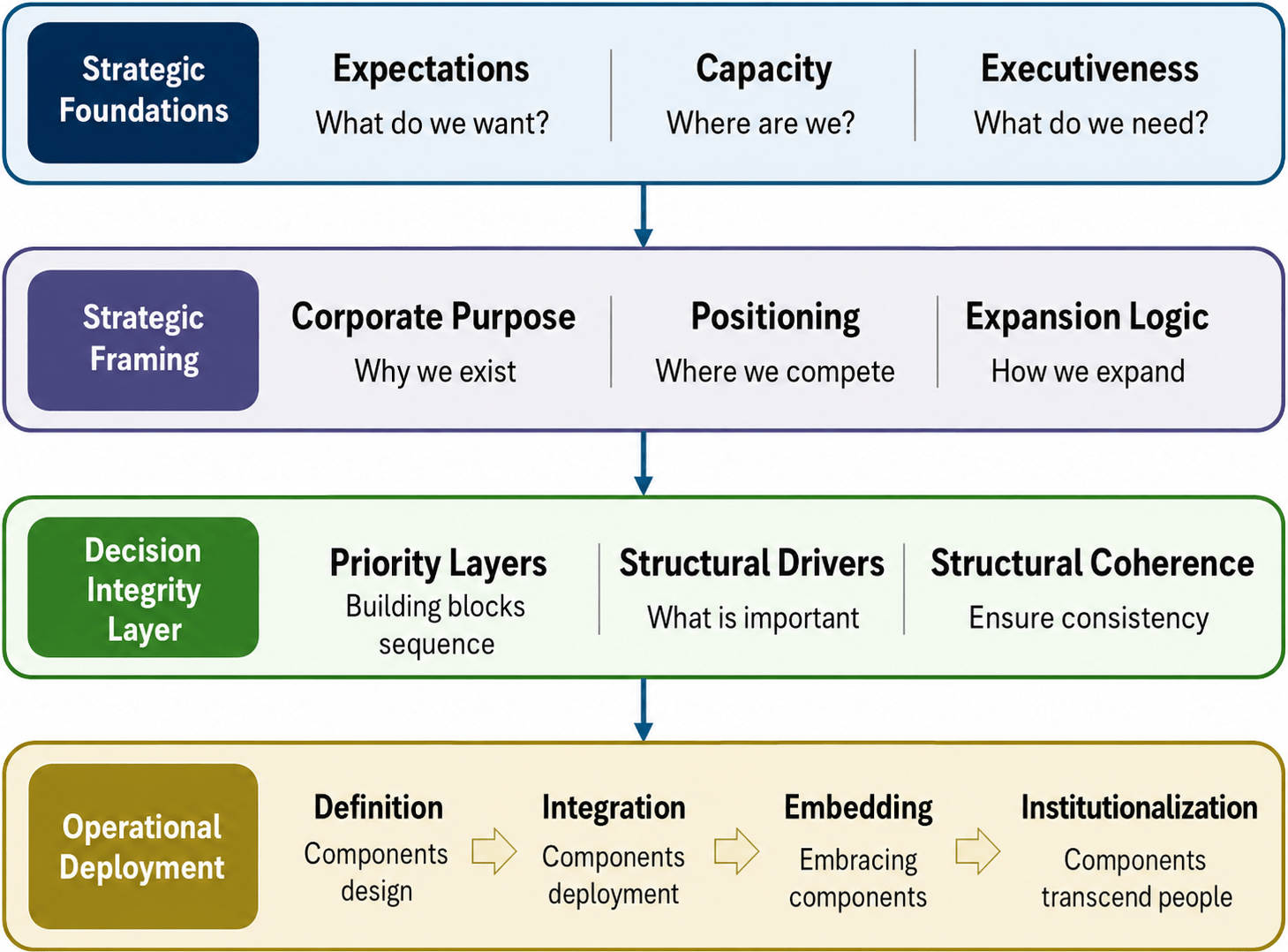
Phase 2: Architecture Design
Following validation, the organization’s target architecture is defined, including the configuration of components, selection of deployment capsules, and alignment with strategic objectives.
Phase 3: Deployment
The methodology is deployed through the progressive activation of capsules, integration across components, and use of tools for execution and measurement.
The organization evolves through defined maturity stages: Defined, Integrated, Embedded, and Institutionalized. This progression ensures that improvements become structural, capabilities are sustained, and competitiveness is continuously reinforced.
Phase 4: Transformation and Scaling
A Structured and Viable Transformation System
CA is implemented through a disciplined process that ensures strategic clarity before action, structural alignment before execution, and viability before investment.
By systematically aligning components, activating capsules, and integrating tools within a coherent architecture, the methodology establishes the structural conditions required for sustained performance.
Because CA has been extensively tested across diverse organizational contexts and high-pressure environments, its implementation provides a reliable and execution-proven framework that consistently establishes the structural conditions required to achieve the expected transformation outcomes.
Research and Development Context
The syncplexity model and the Competitive Architecture (CA) methodology are not theoretical constructs.
They are the result of a sustained process of applied research, developed and refined through real organizational contexts across multiple industries, geographies, and competitive environments.
This longitudinal development has enabled the identification of structural performance patterns that remain consistent across heterogeneous conditions, forming the basis of a methodology designed for operational reliability.
THE KNOWLEDGE BASE
Explore the Knowledge Repository
Access the governed cases, strategic insights and validated knowledge assets that document the progressive development and practical application of Competitive Architecture.
From applied evidence to authoritative knowledge.
YOUR NEXT STEP
From understanding to transformation
A clear path from the model to methodology – and into practical impact.
01
THE MODEL
syncplexity
Understand why organizations lose competitive power – and what creates sustainable advantage.
02
THE METHODOLOGY
Competitive Architecture
Learn how competitiveness is structured, aligned, and executed across the organization.
03
THE INSTITUTION
SPX Prestige School
Apply the model and methodology through programs, diagnostics, learning, and strategic transformation – delivered with precision.
The natural operational exit: From knowledge to capability. From capability to results.